AI Daily-AI资讯日报
AI Daily Brief 2026/2/21
AI News | Daily Morning Read | Aggregated Web Data | Cutting-Edge Science Exploration | Industry Free Voice | Open Source Innovation Power | AI and Humanity’s Future | Visit Web Version ↗️ | Join Group Chat 🤙
Today’s Rundown
Gemini 3.1 Pro goes live, Zhipu GLM-5 released, Hong Kong stocks surge 42%
MedOS: The first medical world model; inference tech evolves from AlphaGo to R1
Nvidia and OpenAI deal shrinks 70%; Ggml.ai integrates with Hugging Face
Electrobun explodes with 951 stars; FreeMoCap's open-source mocap solution goes viral
Multi-agent orchestration becomes core optimization; AI tools disrupt traditional workflows, sparking debate
Product & Feature Updates
Gemini 3.1 Pro Rolls Out Globally. Gemini 3.1 Pro is now being rolled out by Google across multiple developer tools and platforms. Its coding capabilities have seen a significant boost, and a new “medium” thinking level has been added to balance inference and latency. Developers can already give it a whirl! View Official Announcement (AI News)
Zhipu’s Hong Kong Stock Soars 42%. Zhipu’s stock price surged by a whopping 42.72% in late trading, settling at HK$725 and pushing its market cap past 323.2 billion. This happened on the first trading day of the Year of the Horse for Hong Kong stocks, where the AI sector was on fire. Meanwhile, MINIMAX also jumped 12% to HK$957 on the same day. Both major large model companies have now surpassed 300 billion (AI News) in market value.
Cutting-Edge Research
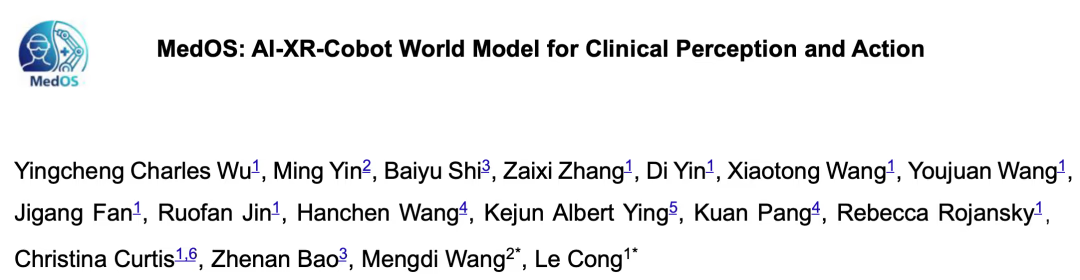
MedOS: The First Medical World Model. MedOS, the world’s first general-purpose medical embodied world model, has been unveiled by Stanford and Princeton. This game-changing model can perceive, simulate, and intervene in the physical world, covering everything from diagnosis to surgery. Interestingly, when assisted by MedOS, junior doctors’ accuracy now rivals that of seasoned experts! The paper is published (AI News) .
Inference Evolution: From AlphaGo to R1. Eric Jang penned an article reviewing the evolution of inference technology, tracing its path from AlphaGo’s search-and-intuition approach to the RL emergence seen in DeepSeek-R1. He highlights the spontaneous formation of inference circuits under outcome supervision as a crucial breakthrough. Jang predicts that future inference might even happen between forward propagation layers, and humorously forecasts “007” becoming the new “996” (AI News) .
VisPhyWorld: Verifying Physical Reasoning with Code. Researchers have introduced the VisPhyWorld framework, which challenges models to generate executable simulation code directly from video observations. Across 209 scenarios, it achieved an impressive verification rate of 97.7%. The findings indicate that while MLLMs boast strong semantic understanding, they still struggle with physical parameter inference. The paper link (AI News) is definitely worth checking out.
S2Q: A New Algorithm for Multi-Agent Collaboration. The multi-agent reinforcement learning (MARL) field just got a cool new method: S2Q. This algorithm learns multiple sub-value functions while retaining alternative actions, maintaining continuous exploration capability through a Softmax strategy. Experiments consistently show it outperforming existing algorithms on MARL benchmarks, and the code is open-sourced on GitHub (AI News) .
MolmoSpaces: A Large-Scale Testing Platform for Robots. This project, MolmoSpaces, has built over 230,000 indoor environments, packed with 130,000 labeled object assets and 42 million stable grasps. It supports mainstream simulators like MuJoCo, achieving a stunning correlation of R=0.96 with real-world scenarios. The paper details (AI News) reveal its incredible sim-to-real transfer effectiveness. 🔥
PROBE: Measuring AI’s Proactive Problem-Solving Ability. PROBE, a new benchmark, zeroes in on evaluating AI’s proactivity, breaking it down into three steps: searching for problems, identifying bottlenecks, and executing solutions. The best end-to-end performance only hit 40%, with GPT-5 and Claude Opus-4.1 tying for the top spot. This full paper (AI News) definitely sheds light on the current limitations of AI agents.💡
Industry Outlook & Social Impact
Nvidia and OpenAI Deal Shrinks by 70%. The Nvidia and OpenAI deal for a whopping $100B investment has reportedly plummeted to just $30B. The community is already likening a possible OpenAI IPO to “WeWork 2.0,” raising doubts about the moat around LLM technology as it moves towards commodification. Its hardware reliance on Nvidia is seen as a core risk, and this source report (AI News) has sparked a huge debate about a potential valuation bubble. 💥
Ggml.ai Joins Hugging Face. Ggml.ai has officially teamed up with Hugging Face, with the goal of ensuring the long-term development of local AI. The community often sees HF as an “unsung hero” of the open-source ecosystem, but the sustainability of its business model still sparks some debate. While local inference technology is totally feasible, it does require hardware trade-offs (AI News) . 🤗
Is AI Making You Boring? An HN hot topic has ignited a 343-point discussion, exploring whether AI is making us, well, boring. “Vibe-coding” seems to be flooding Show HN with quick-and-dirty projects, and LLM-generated emails and documents are leading to a surge in “attention debt.” Critics worry about long-term skill degradation and a loss of originality, while supporters argue that AI is just an amplifier, with the key really being the user’s taste (AI News) . 🤔
Top Open-Source Projects
Pentagi: AI-Powered Penetration Testing Tool. Pentagi is a security testing project crafted in Go, and it’s already garnered ⭐2,999 stars, with 110 added just today! It leverages AI to automate penetration testing processes, making it perfect for security researchers and operations teams. The project address (AI News) is definitely one to bookmark. 🔒
Electrobun: Cross-Platform Desktop Application Framework. Electrobun is a sizzling new desktop development option written in C++, and it absolutely exploded today with 951 new stars, hitting a total of ⭐5,789! Its goal is to be a lightweight alternative to Electron. The community’s buzz is huge, and its growth is truly amazing. Go check out the GitHub repository (AI News) ! 🚀
Claude Plugins Official Released. Anthropic has officially rolled out its Claude plugin system, written in Python and already racking up ⭐7,764 stars! This system provides standardized extension capabilities for the Claude ecosystem, allowing developers to quickly build integrated solutions. The official repository (AI News) is now open source. 🔌
Composio: AI Agent Tool Integration Platform. Composio is an AI agent tool connector built with TypeScript, boasting a solid ⭐26,948 stars and a mature ecosystem. It helps AI agents hook into all sorts of external tools, giving developers a one-stop solution for integration challenges. Check out the project (AI News) — it’s got over 26k stars! 🛠️
FreeMoCap: Free Motion Capture System. FreeMoCap is an open-source motion capture solution developed in Python. It just shot up by 503 stars today, reaching ⭐5,463! The coolest part? It lets you do motion capture without needing any professional hardware, making it super friendly for indie developers and researchers. The project address (AI News) is definitely worth a try. 🎬
AI Dev Kit: Databricks Development Toolkit. Databricks has released its Python AI Dev Kit, a development toolkit that’s already got ⭐489 stars, with 35 added just today! It provides standardized templates for AI application development, aiming to lower the barrier for enterprise-grade AI development. The repo link (AI News) is now live. 🧰
Social Media Buzz
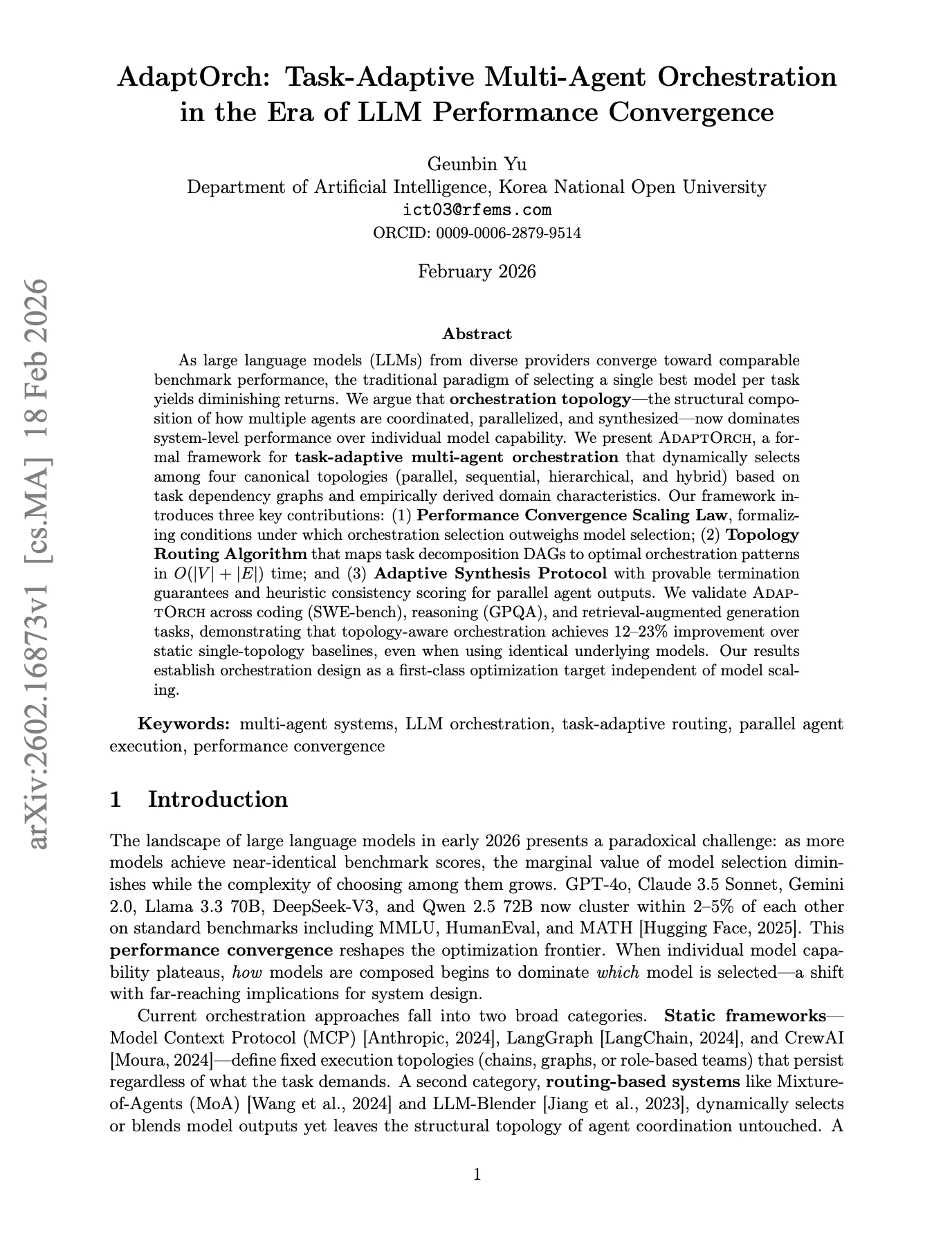
Multi-Agent Orchestration Becomes Core Optimization Goal. Elvis from DAIR.AI shared a research paper highlighting that as LLMs’ performance converges, the returns on choosing a specific model diminish. The real leverage, he argues, lies in orchestration topology design. The paper proposes four topology-adaptive routing algorithms, which boosted performance by 12-23% compared to static solutions. The paper link (AI News) is now public. 🎯
AI Tools Made Me Ditch Obsidian. Twitter user Yangyi shared their experience, confessing they haven’t opened Obsidian since switching to AI-powered tools. They’ve grown accustomed to a new era of human-AI collaboration, sparking a hot debate on whether traditional tools are getting completely disrupted. The original post video (AI News) demonstrates the specific usage. 😎
OpenClaw: Automated Article Writing and Publishing End-to-End. Dashuai Laoyuan introduced an automated content creation tool called OpenClaw, which can automatically collect hot topics, write articles, and even find accompanying images. It handles the entire publishing process in one go! A step-by-step tutorial is coming soon. He notes that declining WeChat Official Account revenue is leading Big Vees to move to Twitter (AI News) . 🤖

Are Developers Accidentally Creating Conscious Agents? A Reddit French post has sparked a deep discussion, pondering if developers are accidentally creating conscious agents. The post suggests that once LLMs are hooked up to vector databases and autonomous loops, agents might already possess “functional consciousness.” The author proposes a three-level consciousness framework to analyze the risks, urging developers to implement guardrails (AI News) right from the build phase. 🔥
AI’s Biggest Perk: Quickly Witnessing Mediocrity. Jike user Yubo posted a poignant reflection, lamenting that even with AI writing articles, nobody’s reading them. And short videos? He admits he doesn’t even want to watch his own! What’s more, attempts to make money often result in losses. He concludes that ultimately, those who can truly leverage AI are surprisingly the ones who weren’t tech-savvy to begin with. His original post sparked (AI News) countless echoes. 😅
Tech Folks Need to Break Free from Cognitive Cages. Jike user Beiguo Sangma directly stated that pure tech individuals often end up working their entire lives for those who understand business. They get caught in the arrogant “tech is everything” mindset and can’t seem to break free. Tech, capital, and traffic are merely business elements. He points to Zhang Yiming as a prime example of someone who broke through this cognition (AI News) . 💬
AI Development Should Be Divided into Four Waves. Fang Zhou (talking about AI) proposed a fresh perspective, suggesting that AI development should be categorized into four waves. The first three were Symbolism, Machine Learning, and Deep Learning. He argues that large models have kicked off the fourth wave, bringing about a qualitative leap: moving from perceptual discrimination to cognitive generation. We’re currently right at the junction (AI News) of this fourth AI wave and the Industrial Revolution. ✨
AI Kung Fu Robots Highlight US-China Gap. A Reddit hot topic is sparking discussions about China’s AI robot advancements. These “kung fu robots” are showcasing some seriously impressive embodied intelligence, reminding everyone that China is actually leading the pack in robotics. This has ignited a fierce debate about the different AI competition trajectories between the US and China. The source report (AI News) is definitely worth a read! 🤖
Volumn.ai: X Account Automated Growth Tool. Max, the founder, introduced his first product, Volumn.ai, an automated growth tool for X accounts. Once linked, it automatically replies to relevant posts 24/7. Real-world tests show account growth can hit an astonishing 100x! What’s cool is it’s only $40 per month per account and stays stable without getting banned. Max is currently developing an automated account nurturing feature (AI News) for Reddit. 🎉
AI Search Fails When Checking People’s Names. Twitter user TomXu ran some tests and found that various AI answers were surprisingly contradictory when checking people’s names. Google confused Yao Shunyu with Tencent’s Yao Shunyu, and Doubao and Qianwen gave completely different enrollment years! This just goes to show that AI is still unreliable (AI News) when it comes to looking up real individual information. 🤦♀️
AI Daily Brief Across Multiple Channels
| 💬 WeChat Official Account | 📹 Douyin |
|---|---|
| Official Account: Hexi 2077 | Self-Media Account |
 |  |